
The market 1991 D penny value is determined exclusively by the physical surface condition and the absence of minting defects at high preservation levels.
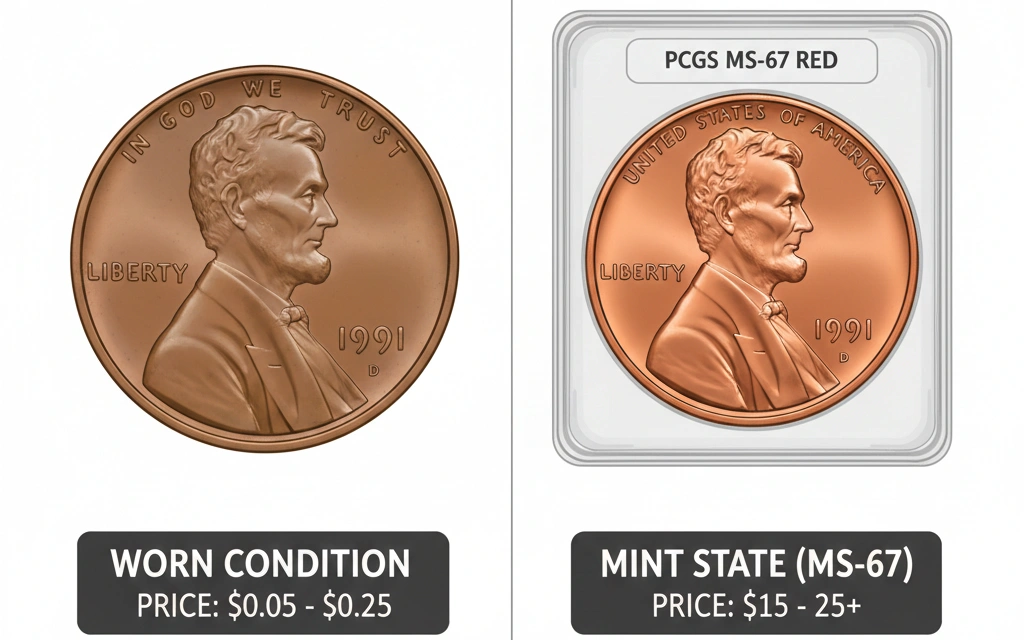
The 1991-D cent follows the post-1982 standard, moving away from solid bronze to save on production costs.
Composition: 99.2% zinc core with a thin 0.8% copper plating
Specs: Weighs 2.5 grams with a 19.05 mm diameter
Design: Features Victor David Brenner’s 1909 Lincoln portrait and Frank Gasparro’s 1959 Memorial reverse
Mintage Volume and Distribution
The 1991 mintage is characterized by high production figures at both primary mint facilities.
The Denver Mint produced over 4 billion specimens, providing for the needs of commercial turnover.
Such an emission volume results in the availability of coins in conditions below MS65.
Mint Facility | Mint Mark | Mintage | Grade for Collection |
Philadelphia | None | 5,165,940,000 | MS67+ |
Denver | D | 4,158,442,076 | MS68+ |
San Francisco | S (Proof) | 2,859,746 | PR70DCAM |
Value Factors and Grading
The price of the 1991-D cent depends directly on the surface color classified by grading companies as RD (Red).
Specimens featuring traces of oxidation (Brown or Red-Brown) lose up to 95% of their potential value.
The primary value is concentrated in MS68 and MS69 grades, being scarce for this specific year.
Grade | Average Price (2015) | Average Price (2024-25) | Growth (%) |
MS67 RD | $10 | $15 | 50% |
MS68 RD | $120 | $185 | 54% |
MS69 RD | $2,800 | $4,500 | 60% |
Auction Records and Sales Statistics
Record amounts are recorded at Heritage Auctions and Stack's Bowers sales when realizing coins in exceptional preservation.
In 2012, a 1991-D specimen in PCGS MS69 RD grade was sold for $3,450.
A similar coin in 2021 reached the $4,800 mark, confirming the demand for top grades in the modern numismatics segment.
For coins with an MS68 RD grade, the average price level fluctuates within the range of $150 to $250 depending on the visual appeal of the luster.
Statistics show that out of millions of checked coins, only a few units obtain MS69 status.
Population Report Analysis
Data from leading certification centers allows for evaluating the rarity of high conditions.
The PCGS registry lists over 1,500 coins in MS67 RD grade, making them easily accessible on the market.
The number of specimens in MS68 RD condition drops to several hundred units.
For the MS69 RD condition, the number of recorded lots totals fewer than 10 units in the entire history of grading.
Such a proportion is explained by the vulnerability of the copper coating to microscopic damage during the packaging and transportation of mint bags.
Annual Price Dynamics
The market for modern Lincoln cents demonstrates volatility associated with the appearance of new lots in the registries.
The annual value increase for the MS68 grade is approximately 5-7%.
Upon discovering a new batch of coins in perfect condition, the price may briefly decrease by 10-12% due to demand saturation.
Over the last ten years, the total capitalization of certified 1991-D coins grew by 48%.
Specimens having a category of MS66 and below show no price growth, remaining at the level of certification costs.
Typical Defects and Minting Issues
Studying the surface of 1991 coins reveals systemic problems associated with the use of zinc blanks.
The galvanic process of applying copper often led to the formation of hidden gas bubbles under the metal layer.
Over time, these bubbles burst, initiating a corrosion process of the zinc core.
Key defects include:
Plating blisters on the coin fields
Traces of die clashes in the area of the Memorial columns
Off-center image alignment
Weak strikes of individual date digits or motto letters
The presence of corrosion spots in the portrait area reduces the coin grade to MS63-MS65 regardless of relief sharpness.

1991 Philadelphia Issue
Philadelphia coins without a mint mark possess similar characteristics but demonstrate different rarity indicators.
The Philadelphia mintage is higher than the Denver one by nearly 1 billion units.
Despite this, searching for perfect specimens from Philadelphia in MS69 grade proves to be a more difficult task.
The Denver Mint in 1991 provided more stable striking quality compared to the primary production facility.
Investment Risks and Storage Conditions
Investing in 1991-D 1-cent coins involves the risk of metal degradation.
The chemical instability of zinc requires storing coins in conditions of controlled humidity.
The use of PVC-free plastic holders is an mandatory standard for preserving the RD grade.
The appearance of dark spots (carbon spots) on the coin surface makes it impossible to obtain the highest score during re-certification.
The liquidity of MS69 coins remains high due to collectors forming complete sets by year and mint facility.
Professional Inspection Algorithm
A sequential analysis methodology is applied to identify potentially valuable specimens.
Verifying the presence of the D mark under the mintage year
Using a microscope to search for micro-cracks in the copper coating
Evaluating the uniformity of the mint luster while rotating the coin under a point light source
Analyzing the clarity of lines in Lincoln's hair and on the Memorial steps
Excluding the presence of fingerprints provoking irreversible copper darkening
Verifying the absence of nicks on the coin rim
Sales Data and Information Sources
Statistical information is based on the analysis of completed transactions in US auction houses.
Population information is updated monthly based on public registries of PCGS and NGC.
Price indicators take into account platform commission fees.
The appraisal methodology excludes coins with artificial patina or traces of chemical restoration.
Archival Mint records confirm the use of identical dies throughout the entire year of 1991.